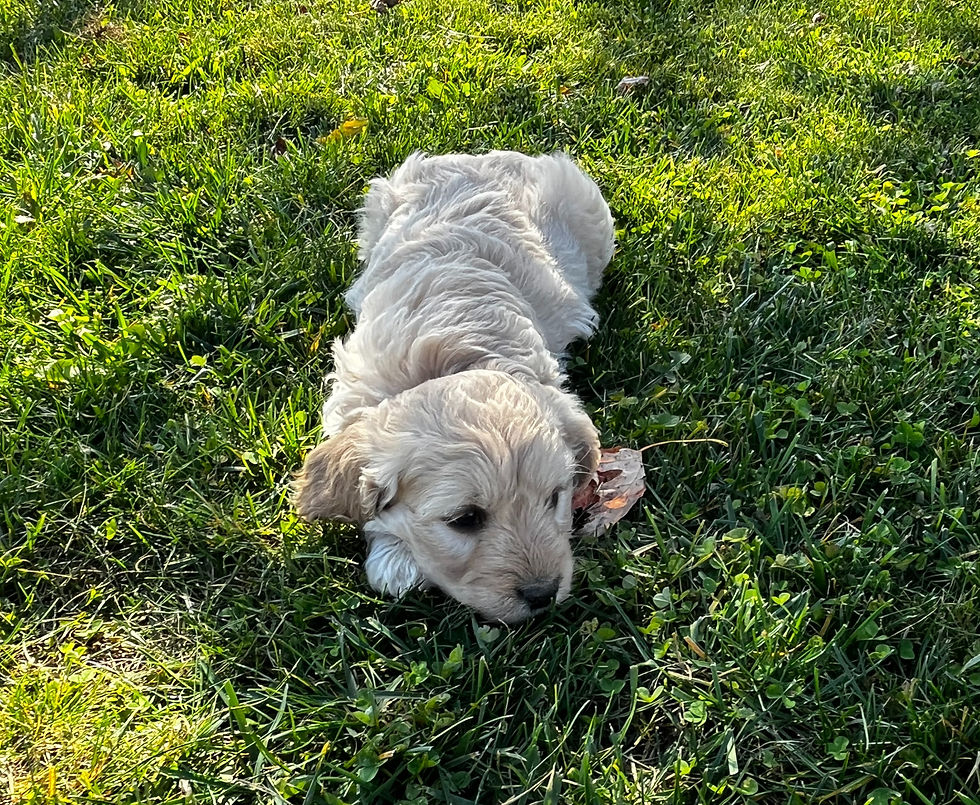
Are Cockapoos Hypoallergenic? Understanding F1 and F1b Cockapoo Coats

Updated: Nov 14
Cockapoos are loved for their friendly personalities, affectionate nature and beautiful coats. But one question we often hear from families considering a Cockapoo puppy is, "Are Cockapoos hypoallergenic?"
The short answer is that no dog is completely hypoallergenic, including Cockapoos. However, many Cockapoos have low-shedding coats, which can make them appealing to families who prefer less loose dog hair around the home.
Not all Cockapoos have the same type of coat. Some have soft, wavy hair, while others have tighter curls or straighter coats. The difference often comes down to genetics and whether the puppy is an F1 or F1b Cockapoo.
At Snowsong Siberians and Cockapoos, we raise both F1 and F1b Mini Cockapoos in Ontario. Understanding the differences between their coats can help families make a more informed decision when choosing a puppy.

What Does Hypoallergenic Mean for Dogs?
The word hypoallergenic is commonly used to describe dogs that are believed to be less likely to cause allergic reactions. However, no breed can be guaranteed to be allergy-free.
Many people assume dog allergies are caused by fur, but the actual triggers are proteins found in a dog's dander (tiny flakes of skin), saliva and urine. These allergens can become attached to hair, furniture, clothing and other surfaces throughout the home.
A dog that sheds very little may leave less loose hair around the house, but that doesn't necessarily mean it produces fewer allergens.
This is an important distinction for anyone considering a Cockapoo because of allergies. Even a curly-coated Cockapoo that rarely sheds can still cause an allergic reaction in someone who is sensitive to dogs.
Are F1 Cockapoos Hypoallergenic?
An F1 Cockapoo is a first-generation cross between a purebred Cocker Spaniel and a purebred Poodle.
Because these two breeds have different coat characteristics, F1 Cockapoo puppies can inherit a variety of coat types. Some have soft waves, others develop curls, and some have coats that are relatively straight.
The amount an F1 Cockapoo sheds can also vary considerably. A puppy that inherits more of the Poodle's coat characteristics may shed less than one with a coat resembling that of a Cocker Spaniel.
This variation is part of what makes Cockapoos unique, but it also means that an F1 Cockapoo cannot be guaranteed to have a low-shedding or hypoallergenic coat.
For families without dog allergies, coat type may simply be a matter of personal preference. For those with allergies, however, it is important to understand that appearance alone cannot determine whether a particular dog will cause symptoms.
Are F1b Cockapoos More Hypoallergenic Than F1 Cockapoos?
F1b Cockapoos are often described as being more hypoallergenic than F1 Cockapoos, but this isn't entirely accurate.
An F1b Cockapoo is produced by breeding an F1 Cockapoo with a Poodle. This means the puppies generally have a greater proportion of Poodle ancestry.
As a result, F1b Cockapoos are often more likely to develop curly or wavy coats that shed less than those of some F1 Cockapoos.
However, less shedding does not automatically mean fewer allergens.
An F1b Cockapoo can still produce the proteins responsible for allergic reactions, regardless of how curly its coat may be.
At Snowsong, we raise both F1 and F1b Mini Cockapoos. We appreciate the different coat textures found in each generation and encourage families to consider the individual puppy rather than assuming that all F1b Cockapoos will have identical coats.
For families concerned about shedding, an F1b Cockapoo may be worth considering, but neither generation can be guaranteed to be suitable for someone with dog allergies.
Do Mini Cockapoos Shed?
Yes, Mini Cockapoos can shed, although the amount varies from dog to dog.
Some Cockapoos shed very little, while others lose a noticeable amount of hair throughout the year. Their coat type, inherited genetics and individual characteristics all play a role.
Cockapoos with curlier coats often retain more loose hair within their curls rather than releasing it onto furniture and floors. This can make shedding less noticeable, but it also means regular brushing is important to prevent tangles and matting.
Cockapoos with straighter coats may shed more visibly, particularly if they inherit coat characteristics from their Cocker Spaniel parent.
It is also worth remembering that a Mini Cockapoo's coat can change as the puppy matures. A soft puppy coat may become curlier, wavier or thicker as the adult coat develops.
For this reason, it isn't always possible to predict exactly how much a young Cockapoo puppy will shed as an adult.

Does Regular Grooming Help With Cockapoo Allergies?
Regular grooming is an important part of caring for any Cockapoo, whether or not someone in the family has allergies.
Brushing helps remove loose hair, prevents matting and keeps the coat in good condition. Professional grooming may also be necessary, especially for Cockapoos with thicker or curlier coats.
For families concerned about allergens, a few simple household habits may also help:
Brush and groom your Cockapoo regularly, ideally with help from someone who does not have dog allergies.
Wash dog bedding frequently to reduce the buildup of hair and dander.
Vacuum carpets, furniture and floors using a vacuum with a HEPA filter.
Consider using a HEPA air purifier in rooms where your dog spends time.
Keep your Cockapoo out of bedrooms if someone in the household experiences allergy symptoms.
These measures may help reduce exposure to allergens, but they cannot eliminate them completely.
If someone in your family has significant allergies, speaking with a physician or allergist before bringing home a puppy is a wise precaution.
Can Someone With Dog Allergies Own a Cockapoo?
Some people with mild dog allergies are able to live comfortably with Cockapoos, while others may experience symptoms even around dogs that shed very little.
Allergies vary from person to person, and reactions can also differ between individual dogs.
Spending time around a Cockapoo before bringing one home may help you understand your immediate reaction, but a short visit cannot guarantee that you won't develop symptoms after living with the dog.
For families with known allergies, especially those involving asthma or more serious reactions, consulting an allergist is the best place to begin.
Choosing a Cockapoo should be based on realistic expectations rather than the promise of a completely hypoallergenic pet.
Choosing Between an F1 and F1b Mini Cockapoo
If you're considering a Mini Cockapoo, you may be wondering whether an F1 or F1b puppy would be the better choice for your family.
Both generations can make wonderful companions, and both are known for their affectionate, playful personalities.
An F1 Mini Cockapoo may have a straighter, wavier or curlier coat, with shedding that varies between individual dogs.
An F1b Mini Cockapoo is often more likely to have a curlier, lower-shedding coat because of its greater Poodle ancestry. However, curlier coats may require more frequent brushing and professional grooming to prevent matting.
Neither generation is automatically healthier, friendlier or more suitable for every family simply because of its coat type.
At Snowsong Siberians and Cockapoos, our Mini Cockapoo parents are DNA tested using Wisdom Panel as part of our responsible breeding program. Our adult dogs live as family pets, either in our home or with carefully selected guardian families, where they receive the love and attention they deserve.
We believe families should have accurate information about the puppies they are considering, including the differences between F1 and F1b Cockapoos.
Frequently Asked Questions About Cockapoo Allergies and Shedding
Are Mini Cockapoos hypoallergenic?
No Mini Cockapoo is completely hypoallergenic. Although some have low-shedding coats, all dogs produce allergens that can cause reactions in sensitive individuals. Coat type and shedding vary between individual puppies.
Are F1b Cockapoos completely non-shedding?
Not necessarily. F1b Cockapoos often have curlier coats and may shed less than some F1 Cockapoos, but no F1b puppy can be guaranteed to be completely non-shedding.
Are curly-coated Cockapoos better for people with allergies?
A curly coat may help retain loose hair, making shedding less noticeable. However, curly-coated Cockapoos still produce allergens through their skin and saliva. A curly coat alone does not guarantee fewer allergic reactions.
Do Cockapoo puppies shed more as they get older?
A Cockapoo's shedding may change as its adult coat develops. Some puppies become curlier and shed less visibly, while others develop coats that release more loose hair. Genetics play an important role in the eventual coat type.
Do Cockapoos need professional grooming?
Most Cockapoos benefit from regular professional grooming, particularly those with thick, wavy or curly coats. Brushing at home is equally important to help prevent tangles and matting between grooming appointments.
Final Thoughts: Are Cockapoos a Good Choice for Families With Allergies?
Cockapoos are wonderful companions, and their beautiful coats are one of the many reasons families are drawn to the breed. However, it's important to remember that no Cockapoo is guaranteed to be hypoallergenic.
F1b Mini Cockapoos are often more likely to have lower-shedding coats than F1 Cockapoos, but both generations can produce allergens. Choosing the right puppy involves considering coat type, grooming requirements, individual sensitivities and your family's lifestyle.
At Snowsong Siberians and Cockapoos, located near Clinton in Huron County, Ontario, we enjoy helping families learn about our F1 and F1b Mini Cockapoos. We welcome inquiries from families throughout London, Kitchener-Waterloo, Toronto and Southwestern Ontario.
Our goal is to raise healthy, well-socialized puppies while helping families make informed decisions about bringing a new companion into their home.
Whether you prefer the soft waves of an F1 Cockapoo or the tighter curls often found in an F1b, understanding the breed's coat characteristics is an important part of choosing a puppy that fits your family.